No pressure washing is not safe for every exterior surface at the same pressure settings. Some surfaces like concrete and brick can handle high pressure just fine. Others like wood siding, roof shingles, and older painted surfaces can be seriously damaged if the wrong PSI or technique is used. The key is knowing which surface needs what approach and that’s exactly what we’ll cover here.
If you’ve been wondering whether it’s safe to pressure wash your roof, your wood deck, your vinyl siding, or your painted fence you’re asking the right question. Most damage we see on Long Island homes didn’t come from skipping cleaning. It came from cleaning the wrong way.
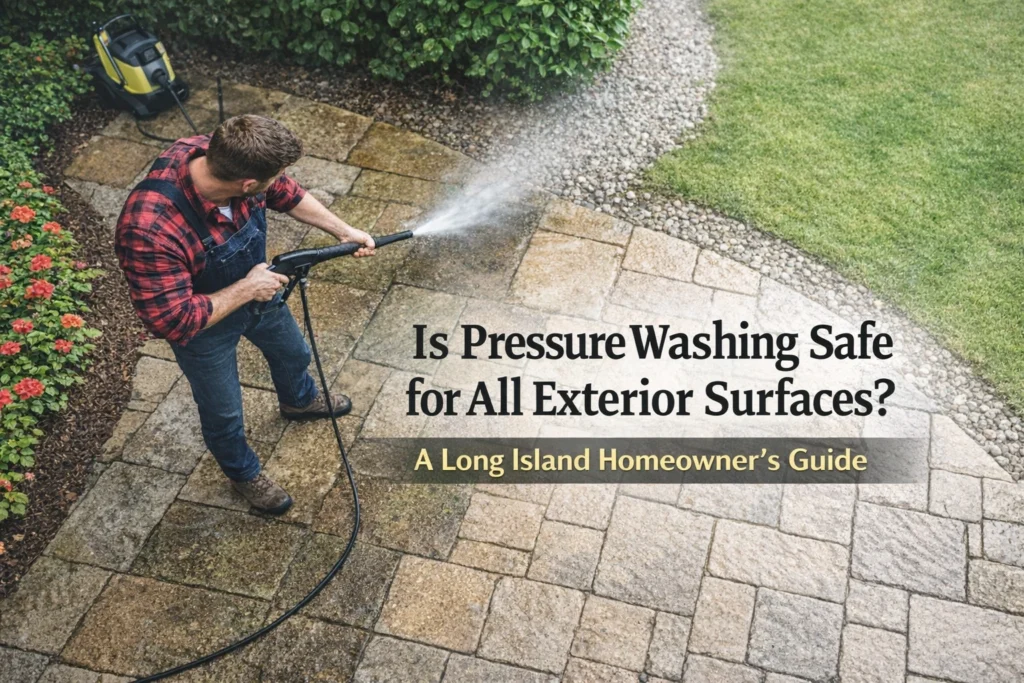
The Short Answer: It Depends on PSI, Technique, and the Surface
Pressure washers aren’t one-size-fits-all tools. The machine itself can typically run anywhere from 1,200 PSI all the way up to 4,000+ PSI. The nozzle angle, distance from the surface, and whether a cleaning solution is used all change the outcome dramatically.
Here’s the quick reference guide for Long Island homeowners:
| Surface | Safe to Pressure Wash? | Recommended Method | PSI Range |
|---|---|---|---|
| Concrete driveway | Yes | Standard pressure washing | 2,500–3,500 PSI |
| Brick exterior | Yes (with care) | Medium pressure + proper angle | 1,500–2,500 PSI |
| Vinyl siding | Yes (with care) | Low pressure + wide nozzle | 1,200–1,500 PSI |
| Wood siding | Caution | Low pressure or soft wash | 500–1,200 PSI |
| Roof shingles | No — use soft wash | Soft washing only | Under 500 PSI |
| Wood deck | Caution | Low pressure + correct angle | 500–1,000 PSI |
| Painted surfaces | Caution | Low pressure, check paint age | 1,000–1,500 PSI |
| Stucco | Caution | Low to medium pressure | 1,200–1,800 PSI |
| Windows/glass | No standard pressure | Soft wash or hand clean | Not recommended |
| Asphalt | Caution | Low pressure only | Under 1,500 PSI |
Let’s go through the surfaces Long Island homeowners ask about most and exactly what the right approach is for each one.
Concrete and Paved Driveways: Yes, Safe for High Pressure
Concrete is the most forgiving surface to pressure wash. It’s dense, hard, and built to take punishment. For a standard concrete driveway on Long Island, we typically run between 2,500–3,500 PSI with a surface cleaner attachment that cleans evenly without leaving streaks or lines.
The one thing to watch for on older concrete: if there are existing cracks, high pressure can widen them. Before we start any driveway pressure washing job, we do a walkthrough specifically to check for cracks and adjust our approach accordingly. Low spots, chip-outs, and crumbling edges all get flagged before the machine turns on.
For Long Island homeowners in areas like Levittown and Hicksville where homes were built heavily in the 1950s and 60s some driveways are quite old. Age matters. Older concrete needs a gentler touch than a freshly poured surface.
Brick Exteriors: Safe But Technique Matters More Than You Think
Brick looks tough. And it is. But the mortar between the bricks is not. High pressure aimed directly at mortar joints can erode them and once mortar breaks down, you’re looking at a much bigger repair bill than a cleaning job.
The right approach for brick pressure washing is medium pressure (around 1,500–2,500 PSI) with the nozzle angled across the surface rather than directly into the joints. We also keep the wand moving never holding it stationary on one spot.
Older brick homes, which are very common in Nassau County towns like Garden City and Rockville Centre, often have softer mortar than newer construction. If your home is older than 30 years, tell us when you call. We adjust the pressure and technique based on the age and condition of the brick.
Vinyl Siding: Safe As Long As the Pressure Stays Low
Vinyl siding is one of the most common exteriors we clean across Long Island, and yes it’s safe to pressure wash. But the key word is low pressure. The mistake most DIY homeowners make is pointing a high-pressure nozzle at vinyl siding from close range, which can crack it, force water behind the panels, and create moisture problems inside the wall.
The right approach is 1,200–1,500 PSI maximum, with a 40-degree wide-angle nozzle, and the wand kept at least 12–18 inches from the surface. We always spray at a downward angle never upward into the seams, which drives water behind the panels.
If your vinyl siding has mold, mildew, or green algae on it which is very common on Long Island homes near wooded areas or with north-facing walls we may recommend a soft washing approach instead. Soft wash uses a low-pressure rinse combined with a biodegradable cleaning solution that kills the biological growth at the root rather than just blasting the surface. The result lasts longer and is gentler on the siding.
Wood Siding: Proceed With Caution
Wood is the most damage-prone siding material when it comes to pressure washing. Too much pressure on wood and you’ll see splintering, raised grain, streaking, and in worst cases the wood absorbs water and swells or warps.
For wood siding, we keep pressure under 1,200 PSI often much lower, around 500–800 PSI and use a wider nozzle angle. We also always spray in the direction of the wood grain, not against it.
If your Long Island home has cedar shake siding, older painted clapboard, or any wood that looks weathered or soft, soft washing is almost always the better choice. It cleans just as effectively as pressure washing for biological growth and surface dirt without any risk of wood damage.
Roof Shingles: Do Not Pressure Wash Use Soft Wash Only
This is the most important one on this entire list. Do not pressure wash asphalt roof shingles. Ever.
Asphalt shingles are covered with granules that protect the shingle from UV damage and give the roof its lifespan. High-pressure water strips those granules off, shortening the life of your roof significantly. One aggressive pressure washing session can take years off your roof’s remaining lifespan.
The correct method for roof soft washing uses very low pressure under 500 PSI combined with a cleaning solution that kills algae, moss, and the black streaking (Gloeocapsa magma bacteria) that’s extremely common on Long Island roofs. The solution does the work. The water just rinses it.
We get calls every season from homeowners who had someone pressure wash their roof, and now they’re dealing with granule loss and premature shingle failure. Don’t let that be you. If someone quotes you a “roof pressure washing” job that’s a red flag. The correct term is roof soft washing, and any reputable company on Long Island knows the difference.
Wood Decks: Low Pressure Only Direction Matters
Your deck can be pressure washed but incorrectly done, it’s one of the most commonly damaged surfaces we see. Too much pressure raises the wood grain, creates fuzzy splintering on the surface, and can dig into softer wood if held too close or too long in one spot.
For deck pressure washing, we use 500–1,000 PSI maximum with a fan tip nozzle, always spraying with the grain of the wood. We keep the wand moving constantly no stopping in one place. After cleaning, most wood decks benefit from a sealer application to protect the freshly cleaned surface, especially going into Long Island winters.
Composite decking (Trex and similar brands) is more tolerant than natural wood but still shouldn’t be hit with high pressure. Check the manufacturer’s guidelines most composite deck makers recommend under 1,500 PSI from at least 8 inches away.
Painted Surfaces: Know the Age of Your Paint First
Painted fences, shutters, trim, and siding can be safely cleaned with low pressure but the age and condition of the paint matters a lot. If your paint is peeling, chalking, or already bubbling, pressure washing will accelerate the damage and you’ll be looking at a full repaint job.
For fence pressure washing on painted wood or painted metal we keep pressure under 1,500 PSI and do a test spot first to check whether the paint is holding. For homes with older lead paint (common in pre-1978 Long Island homes), pressure washing requires special precautions for runoff containment. Always disclose this when you call.
Stucco: Medium Pressure But Watch the Cracks
Stucco is porous and can be pressure washed, but it’s also prone to cracking. Any existing crack in stucco is an entry point for water and high pressure will push water directly into those cracks and behind the stucco substrate. We run around 1,200–1,800 PSI for stucco and inspect the entire surface before starting. Any cracks get flagged and we work around them carefully.
What About Driveways, Patios, and Flat Concrete Surfaces?
These are the safest and most straightforward surfaces to pressure wash on a Long Island property. Patio pressure washing and flat surface cleaning are jobs where high pressure really shines you can see the difference in real time as years of embedded dirt, mold, and staining lift right off the surface.
For paver patios specifically we use a surface cleaner attachment and medium pressure, and we’re careful around the joint sand between pavers. Too much direct pressure on paver joints can wash out the sand and destabilize the pavers. We replace joint sand after cleaning when needed.
The Biggest Mistake Long Island Homeowners Make
Hiring the cheapest quote without asking about technique. A $99 pressure washing special sounds good until the guy shows up with a rented machine, no soft wash capability, and blasts your roof at 3,000 PSI. We’ve seen it. We’ve gotten calls from homeowners after it happened.
The right questions to ask any pressure washing company before they start:
| Question to Ask | Why It Matters |
|---|---|
| What PSI do you use for my roof? | Anything over 500 PSI on a roof is wrong |
| Do you offer soft washing? | Essential for roofs, wood siding, and vinyl |
| How do you handle painted surfaces? | Requires low pressure and a test spot |
| Are you insured? | Protects you if damage occurs |
| Do you do a walkthrough first? | Good companies always assess before starting |
At Long Island Power Wash, we do a walkthrough before every single job. We assess every surface, adjust our equipment settings accordingly, and if something looks like it could be damaged we tell you upfront before we touch it. That’s not us trying to get out of work. That’s us protecting your home.
We Serve Homeowners Across Nassau and Suffolk County
Whether you’re in Syosset, Huntington, Merrick, or Bay Shore we know Long Island homes. We know the housing stock, the siding types, the age of the neighborhoods, and the specific challenges that come with Long Island’s climate and salt air.
If you’re not sure what method is right for your home’s exterior just call us. We’ll tell you exactly what your surfaces need and what they don’t.
Long Island Power Wash 📍 24 Lawrence Ave, Rockville Centre, NY 11570 📞 +1 516-894-2994 🌐 longislandspowerwash.net
Related Services:
